The Amendment Act - Stage 2
The Construction Contracts Act 2002 (CCA) was significantly changed by the new Construction Contracts Amendment Act 2015. The first stage took effect in December 2015, this second stage takes effect 1 September 2016. In the past your only association with the old CCA may have been the processing of contractor's Payment Claims and then the Payment Schedules on behalf of the owner, and maybe if something went wrong, supporting the client in an Adjudication process. This new stage 2 of the Amendment Act will probably increase the impact of the CCA on you and in some cases your clients. This article highlights some of the main issues.
The changes that the Construction Contracts Amendment Act 2015 brought in take effect over 3 stages, with the first of these already in place. They are:
- From 1 December 2015 residential and commercial construction are treated the same under the CCA, with the exception of charging orders. This gives parties to residential contracts full equal access to the CCA’s dispute resolution and payment regimes. Contractors cannot obtain charging orders against residential occupiers.
- From 1 September 2016 design, engineering and quantity surveying work are included under the scope of the CCA.
- Retentions withheld under commercial construction contracts that are entered into or renewed on or after 31 March 2017 must be held on trust.
From 1 September 2016
The definition of "Construction Work" has been extended to include designers (Architects, Architectural Designers, Interior Designers, Landscape Designers, etc), engineers (virtually any discipline) and quantity surveyors. These services will be known as Related Services (CCA section 6(1)(a)).
The definition of ‘Construction Site’ has been changed to include land where construction work is intended to be carried out, but has not yet started. This is to ensure that designers, engineers and quantity surveyors, or clients are not limited in their ability to use the CCA if physical construction work has not yet begun.
Generally the ramifications for those involved in Related Work are:
- Fee agreements will have to meet the requirements of the CCA
- Fee claims should be formal Payment Claims under the CCA (accompanied by Form 1 from the Construction Contracts Amendment Regulations 2015)
- The client should respond with a formal Payment Schedule under the CCA.
- If you have a dispute with your client you can have it Adjudicated. If payments are not made you can resort to Suspending Work (new section 24A) and in some cases a Charging Order (exceptions new section 31)
- If your client has a dispute with you - they can also have it Adjudicated
It is worth noting that there have been a number of concerns expressed by professionals about an adjudication determination process against the designer, not least how this will be viewed by professional indemnity insurance providers. While it was hoped this would be resolved and expanded upon before 1 September, to date there is not much information available, with only indications that some insurers are prepared for it. If you are concerned contact your insurer for details.
Complying with the CCA
You might be wondering "do I have to comply with the CCA"? The answer is yes you should, as you will be taking a risk to ignore all or even a part of it. There are two good reasons for you to ensure compliance:
- There is no contracting out of the CCA (section 12), you can't escape it
- If your fee agreement or fee claims do not meet the CCA requirements
Fee Agreements under the CCA
Any fee agreement comes under the CCA section 14, Parties Free to Agree on Payment Provisions in Construction Contracts. Parties are free to agree on a mechanism for determining:
- Number of payments under the contract
- Intervals between payments
- Amount of each of the payments
- Date each payment becomes due.
- If a single payment is agreed
If no agreement is in place then the default provisions of the CCA apply (section 15). This can't be changed unless both parties agree.
Fee Claim under the CCA
For any fee claim comes under the CCA section 20, Payment Claims. The payee (you) may serve a payment claim (fee claim) on the payer (client) in accordance with the fee agreement.
The payment claim must:
- Be in writing
- Identify the contract (project)
- Identify the work done and relevant period to which the claim relates
- State claimed amount and date for payment
- Indicate how the claimed amount was calculated
- State that the claim is made under the Act
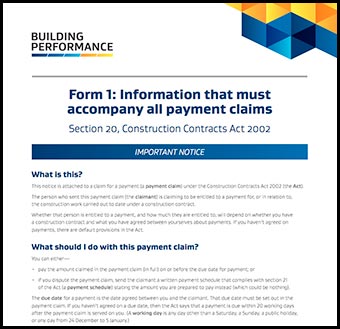
- Be accompanied by an outline explanation to the payer of what they have to do and the consequences of not doing it (see Form 1 below)
The explanation to the payer (client) should be dealt with by attaching to the claim Form 1 - Information That Must Accompany All Payment Claims from the Construction Contracts Amendment Regulations 2015.
Note for NZIA members: The NZIA has under Practice Note PN 3.211 Payment Claims under the Construction Contracts Act 2002, a CCA Payment Claim Pro Forma and a Payment Claim Notice (Form 1).
Payment Schedules under the CCA
Fee payments are basically responded to and handled in the same way that Contractors have been paid under the CCA for some time, and that is with Payment Schedules. Most of you will be familiar with these, but just in case, a Payment Schedule (section 21) must:
- Be in writing
- Identify the payment claim it relates to
- State a scheduled amount
If the amount is less than claimed, the schedule must indicate:
- How the amount was calculated
- Reason(s) for the difference
- Payers reason(s) for withholding payment
Disputes
If a dispute arises the adjudication process under the CCA is available to both the payee and the payer, and can extend beyond payments. The adjudicator (and judge if it comes to that) will take into account how the CCA requirements were met, and if it has any bearing on the outcome.
For further details
 |
MBIE article
MBIE article on the Construction Contracts Amendment Act 2015 |
|
Form
Form 1 from MBIE |