Masterspec
31 Mar 2026
Masterspec Specified: 211 High Street by Ignite
211 High Street transforms the iconic Excelsior Hotel site into a high-quality, sustainable, commercial mixed-use building. The ground floor features...
25 Mar 2026
Why AI Changes How We Trust Construction Specifications
AI has not created the risk of inaccurate or misused construction specifications, but it has made that risk faster, easier to scale, and harder to...
04 Mar 2026
2025 Building Code Update and Building Product Specifications
On 28th July 2025, MBIE's Building Product Specifications (BPS) document came into effect. This document, to be read alongside the Acceptable...
19 Nov 2025
Masterspec Specified: Te Pae Christchurch Convention Centre
Te Pae Christchurch Convention Centre stands as a landmark civic and cultural facility in the heart of Christchurch, New Zealand. Designed by Woods...
15 Oct 2025
Masterspec Specified: Air New Zealand Hangar 4 by Studio Pacific Architecture
The project was designed to meet Green Star environmental standards and includes advanced cladding, roofing, and mechanical systems tailored for...
10 Oct 2025
Bridging the Gap: Empowering Better Specifications for Builders
At this year’s Constructive Conference in Auckland, we asked every delegate we spoke with: “What can we do to improve construction documentation and...
24 Sep 2025
NECO₂ – New Zealand’s Embodied Carbon Repository Goes Live
New Zealand’s construction sector has taken a major step providing New Zealand-centric carbon data with the launch of the first release of NECO₂ – the...
22 Sep 2025
Masterspec Specified: Award Winning Bryndwr House One by AO Architecture
Tucked into a secluded rear site behind a mature, tree-lined driveway in leafy Bryndwr, this new family home forms one half of a pair of residences...
22 Sep 2025
Masterspec Specified: Award Winning Flockhill Sugarloaf by Hierarchy Group
Nestled in the remote Craigieburn Valley of New Zealand’s Southern Alps, Sugarloaf at Flockhill is more than a restaurant — it’s an architectural...
12 Sep 2025
Masterspec Specified: Award Winning He Whare Hono ō Tūwharetoa by DCA Architects of Transformation
In the heart of Taupō, a landmark civic building is redefining the relationship between architecture, culture, and governance.
08 Sep 2025
Masterspec Specified: Award Winning Terrace 12C by Bassett-Smith Architecture
Terrace 12C is a residential development located in Tauranga, designed to maximise site efficiency while maintaining architectural individuality. The...
08 Sep 2025
Masterspec Specified: Award Winning Miller Residences by Oliver Andrew Associates
In the heart of Auckland, the Miller Residences by Oliver Andrew Associates stand as a refined example of contemporary multi-unit housing — where...
01 Apr 2025
Document Referencing and Scheduling with eCert
Our editor team has updated all Masterspec work sections which have references to environmental documents. Where environmental document references...
27 Mar 2025
Update Manager New Features
The new Update Manager features are designed to boost productivity when applying changes to updated work sections. Simplify work section updates with...
03 Mar 2025
CIL is Now Accepting Product Carbon Data for the National Embodied Carbon Data Repository for Construction.
CIL Masterspec is now accepting carbon information in the form of Environmental Product Declarations (EPDs) or Life Cycle Assessments (LCAs) from...
06 Jan 2025
Carbon 2025 and Beyond: Building a More Sustainable Future for NZ Construction
In July 2024, Construction Information Ltd (CIL) and the Building Research Association of New Zealand (BRANZ) announced a partnership to develop a...
01 Nov 2024
Introducing eCert: A Game-Changing Tool for Sustainable Construction
As the New Zealand construction industry increasingly focuses on sustainability and carbon reduction, there is a growing need for tools that can help...
26 Sep 2024
Masterspec Specified: Manawa House by Cube Architecture
"Masterspec has been an indispensable tool for our project Manawa House. During the specification, Masterspec streamlined our entire specification...
26 Sep 2024
Masterspec Specified: Award Winning Ligar Bay Bach by Young Architects
"Masterspec was used for providing a detailed, fully customised, specification as part of our comprehensive project documentation for the Ligar Bay...
25 Sep 2024
Masterspec Specified: Hilltop Home by Jon McAlpine Architecture
“Masterspec is a critical component in our studio. Its user-friendly platform and regular product specification updates, keep us constantly on the...

VRF AIR CONDITIONING - NEW SECTION   

01 Jun 2016

NEW MASTERSPEC SECTION

Introducing a new Masterspec section 7628 VRF AIR-CONDITIONING SYSTEM in Services which relates to the design, supply, installation and testing of Variable Refrigerant Flow (VRF) air conditioning.  It includes:

  • 2-pipe and 3-pipe VRF inverter heat pump multi-system air-conditioning plant with nominal cooling capacities greater than 9 kW
  • air cooled and water cooled types including cooling only and heat pump recovery systems

Although most commonly used in commercial situations, VRF can also be used in domestic buildings.

WHAT IS VRF?

Variable Refrigerant Flow (VRF), sometimes known as VRV, is a step up in complexity from standard split unit heat pumps and comes in two systems:

2 Pipe System

Has heating and cooling mode just like a standard heat pump, but generally with one outdoor condensing unit and multiple indoor units (IDU's).  Although heating or cooling is possible it means that all IDU's have to do the same thing at the same time, although some manufacturers have the facility to vary this.

3 Pipe System    
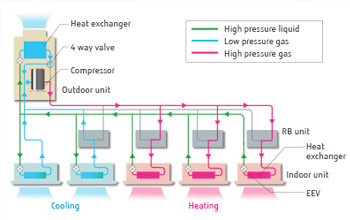
The three pipe system (sometimes referred to as Heat Recovery HR) has a special box that controls the flow of suction gas and hot gas through the evaporator, indoor, coils. By switching from suction gas in the coil to hot gas, the individual IDU's can be switched from cool to heat while other IDU’s remain in cooling mode.  So individual IDU's can be heating, cooling or off, regardless of what the others are doing.

VRF zoning systems are sustainable and cost-effective HVAC solutions. Additional benefits include energy savings, increased comfort, design and installation flexibility, lower maintenance costs, and quiet operation.

DESIGN CONSIDERATIONS

Deciding what HVAC system best suits your application will depend on several variables such as building characteristics; cooling and heating load requirements; peak occurrence; simultaneous heating and cooling requirements; fresh air needs; accessibility requirements; minimum and maximum outdoor temperatures; sustainability; and acoustic characteristics.

VRF ADVANTAGES

Comfort - responds individually to fluctuations in space load conditions, simultaneous cooling and heating, flexibility for zoning, (in particular 3 pipe)

Design Flexibility - single condensing unit can be connected to wide range (types) of IDU's,

Flexible Installation - modular and self contained, enable floor by floor installation and commissioning,

Energy Efficiency - Inverter compressor technology is highly responsive and efficient. The modular arrangement permits staged operation, cooling and heating in a single system which avoids duplicating systems, (in particular 3 pipe).

Energy Savings - Heat recovery, where waste heat removed from cooled rooms is effectively used as a heat source for heating other rooms, (in particular 3 pipe).

Reliability - Continuous operation is possible even if trouble occurs at an individual IDU, similarly for multiple outdoor units.

Retrofit - Particularly good for retrofit situations with restrictive space and different environments, (in particular 3 pipe).

VRF CHALLENGES & LIMITATIONS

Refrigerant Piping - The maximum lengths of refrigerant pipe work for a VRF or any other split system is related to the compressors ability to overcome the pressure drop and for the system to maintain proper oil return. All 'split' systems therefore have a maximum allowable vertical and total refrigeration pipe work length.

Compliance with ANSI/ASHRAE Standards - VRF systems sometimes find it difficult to comply with American standards on refrigeration; especially where a long length of refrigerant piping is involved.  This may be a reflection of the focus of the American standards which tends to be other types of systems not VRF.

Oil Management - As the system has a larger spread, the refrigerant pipes traverse long lengths; hence their pressure testing and protection becomes critical. Long refrigerant piping loops also raise concerns about oil return.

Fresh Air Requirements - Like all split systems, VRF systems do not provide ventilation of their own, so a separate ventilation system is necessary.

Particulate Matter Removal - VRF filter types may not achieve some higher requirements

Environmental Refrigerant Concerns - Not so much of a concern as the new Masterspec section specifies refrigerants R 410A or R407C.  Both these refrigerants are rated very low (0) for ozone depletion, and are relatively low for global warming potential (R407C very slightly lower).  (Source: DuPont Fluorochemicals).  Note; R410A operates at higher pressures than R407C.

LINKS AND SOURCES

ASHRAE Journal
Variable refrigerant flow systems
The Construction Specifier
VRF Zoning Energy-efficiency Data: Five questions specifiers should ask